
Maki Ohkojima
Solo Exhibition
Uzuki | Resonant Wounds
2026.1.17 (Sat.) - 2.14 (Sat.)
Gallery hours: 12:00 – 18:00
closed on Sundays, Mondays, and holidays
* Simultaneous exhibition: Noe Aoki Print Exhibition 1997- 2026
Support: Kanamori Alloy, Keisuke Takemata
Opening reception: January 17 (Sat.), 17:00 – 19:00 * The artist will also be in the gallery.
Talk event: January 24 (Sat.), 18:00 – 19:30
Panelists: Maki Ohkojima, Yosuke Tsuji, Toshiki Ishikura (anthropologist)
We at ANOMALY are pleased to announce the upcoming solo exhibition of works by the art unit Maki Ohkojima (consisting of Maki Ohkojima & Yosuke Tsuji). Titled Uzuki | Resonant Wounds, this will be their first solo exhibition at our gallery, and will run from January 17 (Sat.) to February 14 (Sat.), 2026.
Besides Ohkojima’s representative series so far, the exhibition will also show new works produced especially for it, including paintings, video works, three-dimensional works, drawings, and text (poetry). It is sure to be a milestone in the history of their creative activities.
Thus far, Ohkojima has made deep probes into the “outline of our existence” constituted by birth & death, ceremony & entertainment, geology & the environment, and the life cycle. At the roots of their concerns is always the question of the meaning of “we are.”
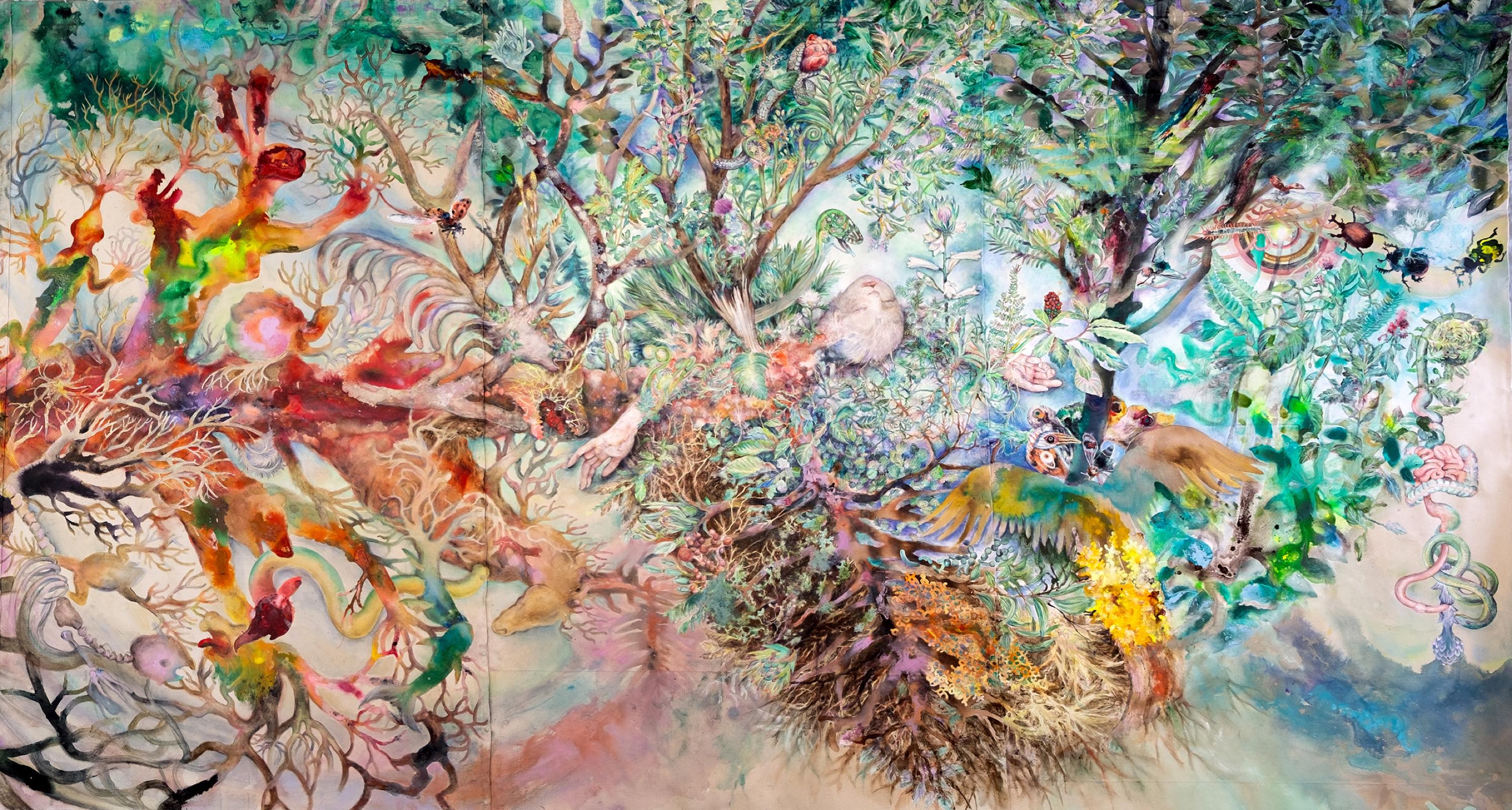 Maki Ohkojima, Ena | Afterbirth, 2019-2022, Acrylic paint, oil painting, pigment, embroidery, soil, lacquer spray, fabric, H223xW395.5cm ©Maki Ohkojima
From 2022 to 2023, Ohkojima visited the Suwa area of Nagano Prefecture, which is said to be the omphalos of the Japanese archipelago. Through their research while residing there, they grappled with the question of how people living on this archipelago were influenced by its geological conditions. Japan is an earthquake-prone country on the Ring of Fire, due to its location on the borderlines between continental plates. In the process, Ohkojima announced their worldview using the term “radical impotency.” This outlook evinces our helplessness about and resignation to land that erupts in volcanic fire and shakes with seismic tremors. As a symbol of this impotency, Ohkojima layers the fissures in the continental plates (the original wound) which the archipelago sits astride on the anterior fontanel opening in the cranium of very young mammals. Behind the related work lies an insight into an ambivalence: the wound that opened at the beginning is both painful for us and a condition making our lives possible.

Maki Ohkojima, Fontanel – SHISHI, 2025, Ceramic, H26.5xW32xD21cm ©Maki Ohkojima
In 2024, Ohkojima took up residence in Mexico for a year with assistance from the Japan Agency for Cultural Affairs, in order to research the country’s history and culture. Underlying today’s Mexico is a variety of elements, including its history of conquest, the wounds of that invasion, the cultural mixture that bloomed on those wounds, and the Mexican outlook on life and death symbolized by the Day of the Dead, one of Mexico’s major festivals. All of these elements embody a living complexity that cannot be encapsulated in “positive or negative” dichotomies. Ohkojima states that they are not moving toward the conquest of pain, but are instead a style of life as a prayer to keep living in a way that seems to embrace pain.

Scene of the exhibition at the international art festival Aichi Triennale 2025. Maki Ohkojima & Agros Art Project, Tomorrow’s Harvest, 2017-2018
©Aichi Triennale Organizing Committee Photography: ToLoLo studio
 Scene of the exhibition at the Maki Ohkojima solo exhibition, Where Lies Your Afterbirth?, KAAT Kanagawa Art Theater, 2025
©Maki Ohkojima Photography: Norihito Iki
In Mexico, Ohkojima experienced birth in accordance with the local midwife practice. Birth is nothing less that than the work of bringing new life into being from a crack in the mother’s body. Ohkojima participated in numerous childbirth rites that retain the vestiges of the Mayan civilization. Through this participation, they say that they were able to get a physical understanding all over again of the analogies of the body and the earth seen in myths and orally transmitted folk tales around the world.
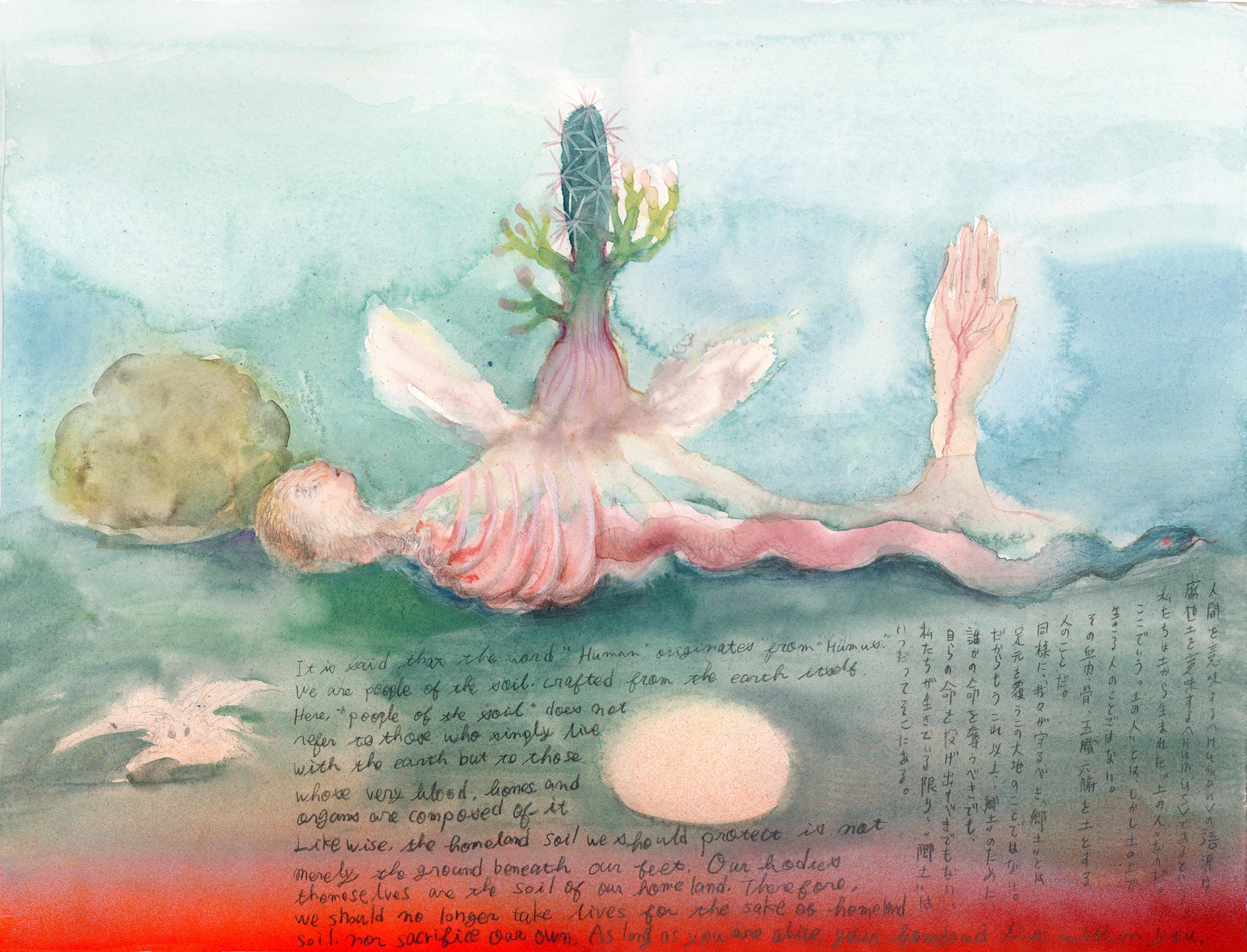
Maki Ohkojima, Homeland, 2025, Watercolor, pencil and acrylic on arches paper, H28.6xW37.8cm ©Maki Ohkojima
The uzuki (渦き) in the title of this exhibition is a term coined by Ohkojima. It indicates the formation of this world through the swirling (uzu / 渦) of the pains (uzuki / 疼き, dull and persistent aches) our lives carry and the wounds at the origin of our fragility as we touch each other, become entangled, and resonate. Properly speaking, we are not isolated individuals, but beings brought to life through the fissures of the earth, apertures of the body, cutting-plane lines of words, and the scars of contact with others―in other words, through such cracks=wounds. Besides hurting, this pain is at the same time proof that we are swirling here together with all creation.
This year, Ohkojima showed the video work The Rule of CoVexation as part of the installation Agora of Multi species displayed at the Seto venue of the international art festival Aichi Triennale 2025. The following passage appears in this work.
“Tears are wounds. They are wounds that constantly hurt us and cannot be closed. However, if these wounds are the very things keeping us alive, we can no longer distinguish them from grace.”
In Ohkojima’s view, the very notion that we “are” means that we exist as a deviation=tear from “nothingness.” This tear constantly hurts. Nevertheless, the hurt is not isolation, but resonance, and it is precisely this resonance that keeps the world alive. Behind the choice of this “swirling” of life as the theme for this exhibition lies Ohkojima’s desire “to bless this life even in the midst of inexplicable pain.”
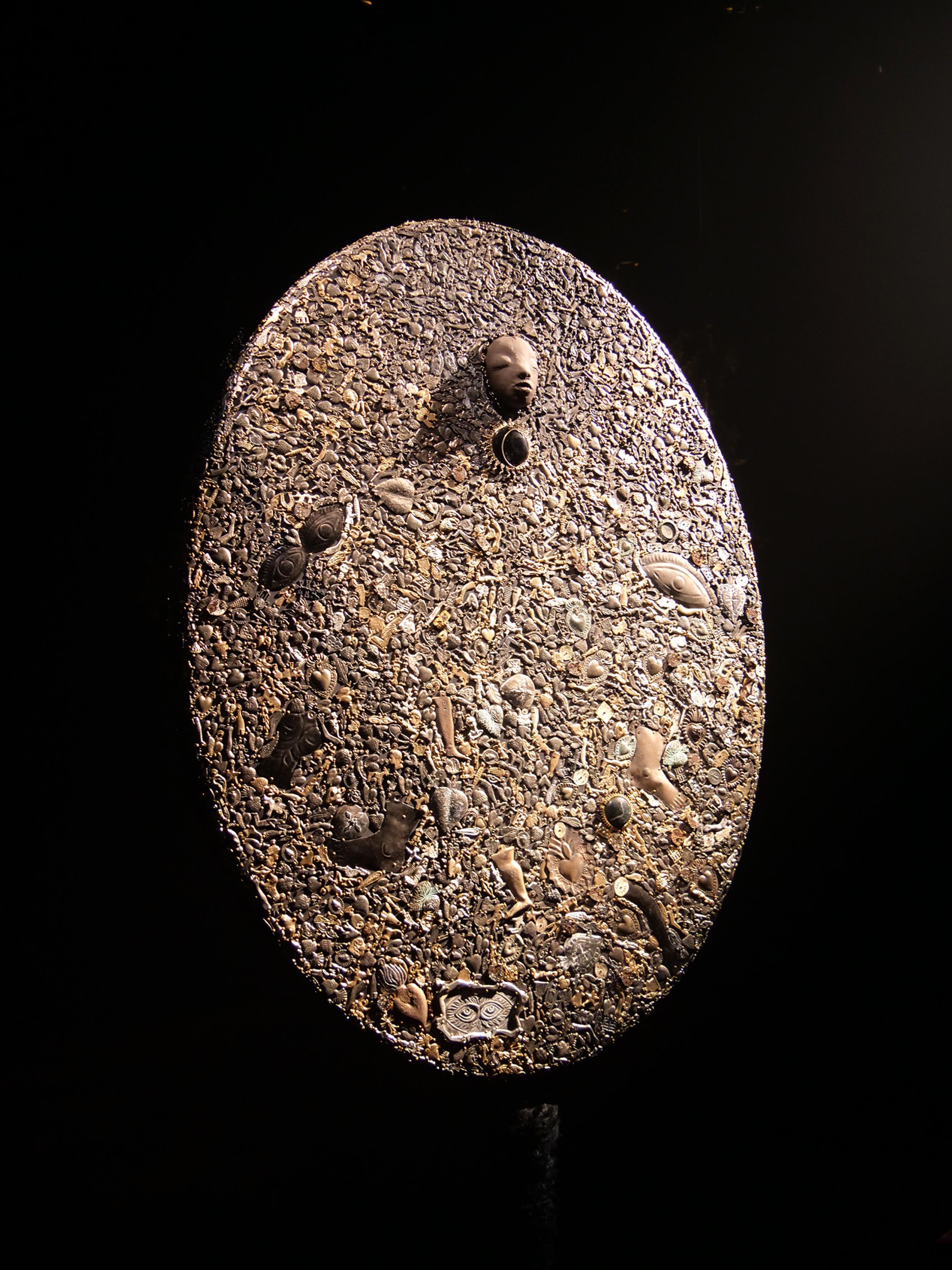
MAQUIS (Maki Ohkojima, Yosuki Tsuji, and Muneaki Kuyama), Milagros – ūnus, 2025, Jade, obsidian, metal, watch parts, ceramic, mirror, wood, etc., H90xW65xD7cm ©MAQUIS
Ena | Afterbirth (2020), the large painting at the core of this exhibition, depicts the scene of bodies & plants, life & weather mingling and wriggling around as one immense biosphere. The exhibition also displays works in various other media including video and three-dimensional pieces. What they present is the form of life transcending divisions and resonating—“swirling,” which is a both universal and extremely earnest worldview.
We would be happy if you could gaze at your own uzuki through this exhibition.
During the run of the exhibition, a talk event is going to be held with the anthropologist Toshiki Ishikura and Ohkojima. Why do people sing, dance, and draw? The two have maintained deep ties for years, and their conversation will delve into the origins of art and traditional theater. We hope to see you at this event.
Maki Ohkojima
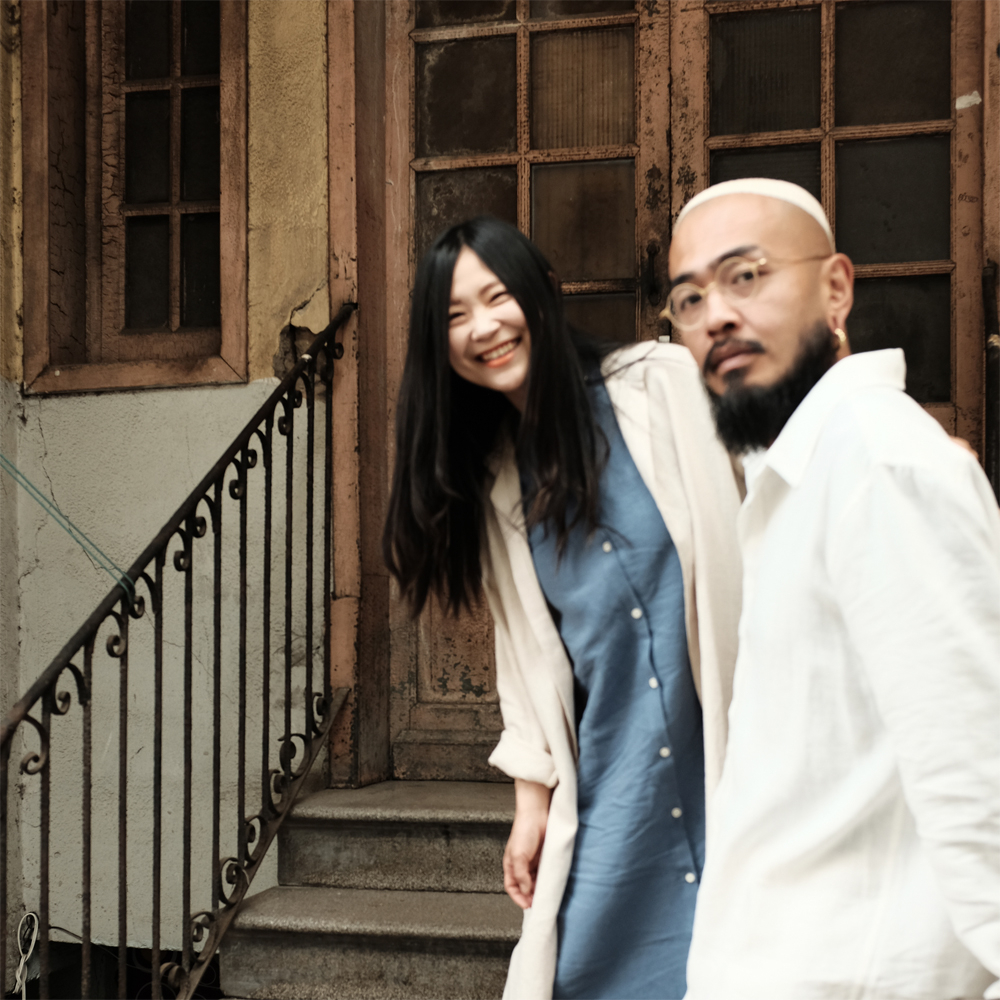
Maki Ohkojima is a Tokyo-based art unit composed of Maki Ohkojima and Yosuke Tsuji. They engage in artistic activities on the theme of “life in a tortuous cycle of entanglement, entanglement and fraying.” Ohkojima themselves produced art during periods of residence in India, Poland, China, Mexico, France, and other countries. In 2017, they participated in a project centered around a Pacific expedition by the Tara, a scientific exploration ship, led by the Tara Ocean Foundation. In more recent years, they have had a hand in scenography in addition to holding exhibitions in museums, galleries, etc.
Their main solo exhibitions are as follows: Where Lies Your Placenta Afterbirth? (2025, KAAT Kanagawa Art Theater, Kanagawa, Japan); On the Navel of the Planet (2025, Sebastian Foundation, Mexico City, Mexico); A thousand Dear Head (2023, Chofu City Cultural Hall Tazukuri, Tokyo, Japan); Maki Ohkojima | Correspondence (2022, Tsukurikake Labo 09, Chiba City Museum of Art, Chiba, Japan); L’oeil de la Baleine / Eyes of Whales (2019, Aquarium de Paris, Paris, France); Birds, sing the songs of the earth, through my bones. (2015, Dai-ichi Life South Gallery, Tokyo, Japan).
The main group exhibitions in which they have participated are as follows: Aichi Triennale 2025 (2025, Aichi Arts Center / Aichi Prefectural Ceramic Museum, Aichi, Japan); Continuous Contours (2022, Sezon Museum of Modern Art, Nagano, Japan); End of the World and Self-centered World (2022, GYRE GALLERY, Tokyo, Japan); COVID-19 Crisis & Amabie (2022, Kadokawa Culture Museum, Saitama, Japan); Re construction, an exhibition celebrating the 35th anniversary of the Nerima Art Museum (2020, Nerima Art Museum, Tokyo, Japan); AOMORI EARTH 2019: AGROTOPIA –WHEN LIFE BECOMES ART THROUGH LOCAL AGRICULTURE (2019, Aomori Museum of Art, Aomori, Japan); Setouchi Triennale 2019 (2019, Awashima, Kagawa, Japan), and others. As the above indicates, Ohkojima has taken part in numerous group exhibitions inside and outside Japan.
Ohkojima’s main publications include World (published by Sakuhinsha) and Eyes of Whales (published by museum shop T). In 2023, Maki Ohkojima entered into a partnership for full-fledged collaborative production with Yosuke Tsuji, an editor who had long been involved in her production activities. Ever since then, the two have been active as an art unit while retaining the name “Maki Ohkojima.”
©︎Aki Kawakami