
Tomohito Wakui|“Paranoid, Is Life for Enjoying or for Ending?”
- Update Date: 2026.02.28
- Category: Exhibition
Tomohito Wakui
Performance “Paranoid, Is Life for Enjoying or for Ending?” 2026
will be held during solo exhibition “God, I, Ego” opening reception.
Opening reception:March 7 (Sat) 17:00 – 19:00
ANOMALY
*This exhibition contains works that include flashing lights and strobe effects. Visitors who are sensitive to light or who have concerns about their physical condition are kindly advised to exercise caution when viewing the exhibition.
In addition, some works include unpleasant or intense sound. Visitors with auditory sensitivities are asked to use their own discretion when entering the exhibition.
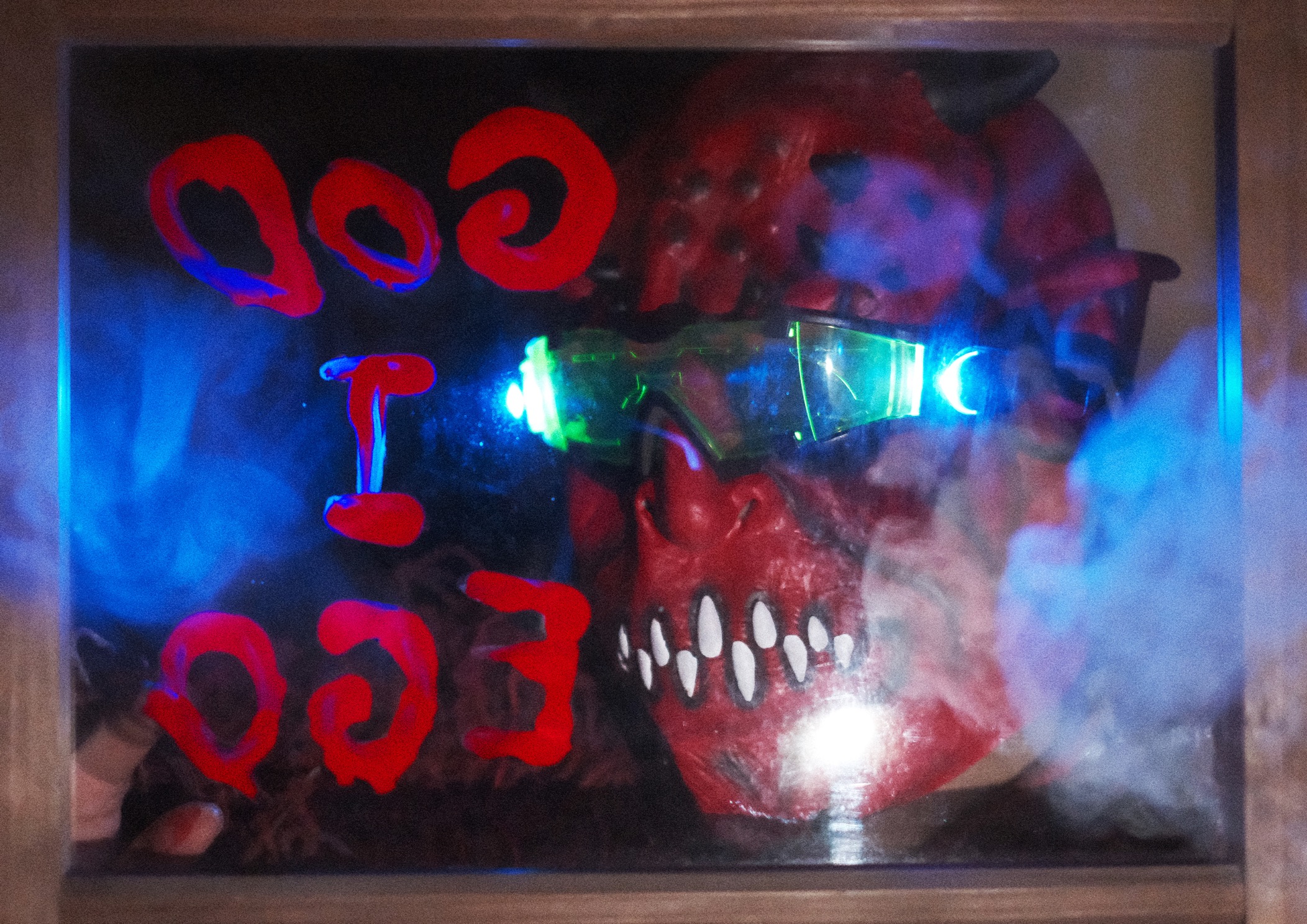
Performance “Paranoid, Is Life for Enjoying or for Ending?” 2026
“Think I’ll lose my mind if I don’t find something to pacify.”
— Black Sabbath, Paranoid, 1970
Released in 1970, Black Sabbath’s second album Paranoid marked the definitive end of the 1960s in rock music and gave rise to a new movement: heavy metal. Unlike earlier rock, it employed heavy, dark riffs and bass-driven soundscapes, and—true to its title—its lyrics hover at the edge of depression and drugged states, foretelling the global madness that would unfold in the decades to come. The oppressive world of this iconic track Paranoid concludes with the line:
“I tell you to enjoy life, I wish I could, but it’s too late.”
Literally, this translates to “You enjoy life; I wish I could, but it’s too late.” Yet the lyric has sparked considerable discussion due to a sinister mishearing: “enjoy life” can be perceived as “end your life.” Depending on the listener’s perspective, either ending can be interpreted as valid. In this sense, the conclusion of Paranoid offers a highly suggestive narrative at a pivotal turning point in 1970: the feeling of being left behind by the world’s great advances, a defensive posture toward progress itself, and the constant pressure of being confronted with the majority of the world’s affairs, even when they should be irrelevant to oneself. Fundamental emotions such as love or happiness are relegated to the minor key, while one must constantly live with the accounting of the whole world. These sensations and realities continue to resonate today, like a continuous low note underscoring our lives in 2026.
Later, in 1975, Black Sabbath released Sabotage, featuring tracks such as “Don’t Start (Too Late),” “Am I Going Insane (Radio),” and “Symptom of the Universe.” Written amid legal battles with their former manager, the album is both a return to roots and a continuation of the progressive elements of Paranoid, and in many ways can be seen as a culmination of the themes explored in that record—whether it is about enjoying life or ending it.
More than half a century has passed since 1970, when the idealism of the 1960s collapsed and harsh realities began to emerge. Today, in a world where everyone seems to be sick in some way or addicted to something—a fully “post-drug” condition—I feel the urge to once again properly give up on or hope for this world. It was at this moment that Paranoid of 1970 descended upon me. I want to restart from Paranoid 1970 and grasp the Paranoid of 2026. These next few hours are for that purpose.
In a world where everyone lives in a kind of makeshift house, surviving with the aid of mild sedatives and convenient faith, I wish to confront my body and, together with all of you, consider what Paranoid 2026 might be. Even if it comes too late, even if it is a delusion, I want to do it nonetheless.
Tomohito Wakui
Tags: Tomohito Wakui